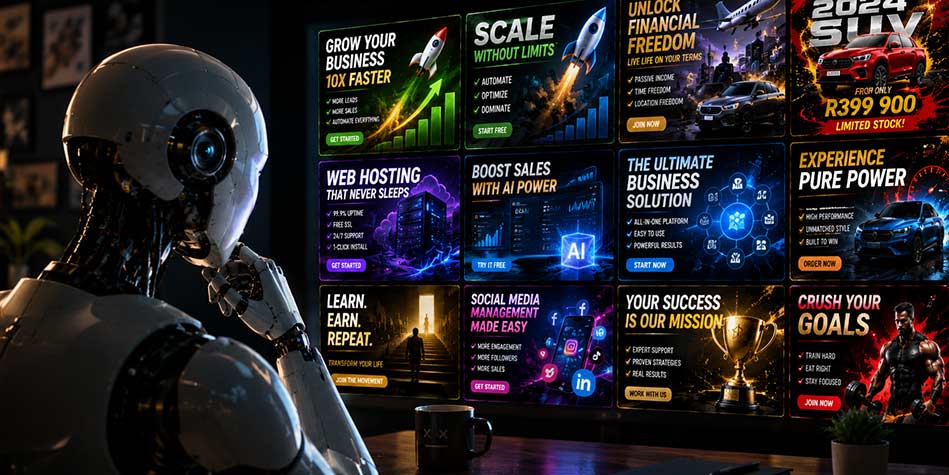
AI image generators are getting ridiculously good lately. You can open ChatGPT, type something like “make me a professional ad for my business,” and within seconds you’ve got dramatic lighting, giant bold headlines, glowing graphics and enough floating icons to make it look like your company just unlocked a premium subscription to “Ultimate Business Success.”
And honestly? At first glance, a lot of it does look impressive.
AI has made it incredibly easy for almost anybody to generate polished-looking content without needing years of design experience. Business owners who’ve never touched Photoshop are suddenly pumping out social media ads before breakfast and to be fair, I completely understand the appeal. Fast, cheap and “good enough” is very tempting when you’re trying to run a business.
But there’s a problem starting to appear online, and once you notice it, you genuinely can’t unsee it.
Everything is starting to look the same.
Lately my Facebook feed feels like it’s being designed by one extremely over-caffeinated young designer. Every second ad has the exact same visual formula. Giant text, dramatic gradients, floating symbols, icon blurbs stacked on top of feature blurbs.
Different industries. Same ad.
One company is selling hosting. Another is selling websites. Another is selling business coaching. Another is somehow selling cars. Yet they all look like variations of the same template wearing slightly different outfits.
The strange part is that these ads aren’t always technically bad. Some are actually put together fairly well. The issue is repetition. The more businesses use the same AI-assisted visual language, the less unique it feels. What originally looked modern starts feeling mass-produced very quickly.
It reminds me of the AI action figure trend. At first, everyone thought it was creative seeing themselves packaged like collectible toys. Then every second person on the internet did it. Suddenly it stopped feeling clever and started feeling like people were all showing off the exact same joke in different clothing. The same thing is happening with AI-generated business ads right now. The “wow” factor fades incredibly fast once the entire internet starts using the same tricks.
That’s where branding quietly starts taking damage.
I started thinking about this recently and decided to test something. What would happen if some of the world’s biggest brands started advertising using this exact AI-heavy Facebook ad style? So I created parody examples for Apple, Nike and McDonald’s using all the common ingredients.
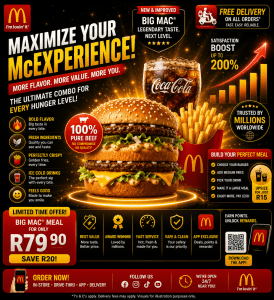

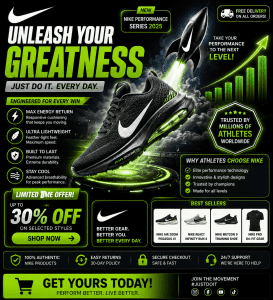
The moment Apple starts screaming “MAXIMIZE YOUR EXPERIENCE” while rockets launch behind an iPhone, the brand instantly starts feeling less premium. Nike suddenly looks like it’s selling crypto courses. McDonald’s somehow transforms from a fast-food company into what feels like a motivational seminar with fries.
The interesting part is that the designs still technically look good. They just feel completely interchangeable.
The same thing became even more obvious when I tried the vehicle dealership style ads.
You know the ones. Giant comic-book text. Neon paint splatters. Massive prices. “LIMITED STOCK!!!” written like civilisation is collapsing by Friday afternoon. Every feature has its own glowing box. Every box has its own icon. Every icon apparently needs an arrow pointing toward it just in case your eyes accidentally wandered somewhere peaceful for half a second.
So naturally, I created fake Porsche and Mercedes-Benz ads using that exact visual formula.
And instantly, both brands lost their luxury feel.


Not because the ads were ugly, but because the visual language completely clashed with what those brands represent. Porsche advertising is usually calm, cinematic and restrained. One beautiful image. One confident sentence. Enough breathing room to let the product actually speak for itself instead of screaming at you like a late-night furniture clearance sale.
That contrast says everything.
Obviously, I’m not anti-AI at all. I use AI tools constantly in my own workflow. They’re brilliant for brainstorming, editing, concept generation and speeding up repetitive tasks. But there’s a huge difference between using AI as part of a professional creative process and relying entirely on AI to make branding decisions for you.
Because good design was never really about access to tools. Everybody now has the tools.
The real value comes from knowing what to use, what to avoid and when to stop adding things before your ad starts looking like a transformer exploded inside Canva.
That’s the part AI still doesn’t understand. And unfortunately, customers notice this stuff more than businesses think they do. Maybe not consciously at first, but people absolutely pick up on visual trends. When every second business uses the same AI-generated layouts and the same cluttered “look at me!” design style, customers start associating it with low-effort marketing.
And fair or unfair, perception matters.
If a business cuts corners in its branding, people naturally start wondering where else they might be cutting corners too.
That’s why professional branding still matters more than ever right now. Ironically, AI hasn’t made good design less valuable. It’s made originality more valuable because standing out is becoming harder as everything slowly drifts toward the same recycled visual style.
So yes, use AI. Learn it. Experiment with it. Push it to its limits. Just don’t mistake “easy to generate” for effective branding.
Because right now, the internet is becoming flooded with businesses using the exact same visual language. The same floating icons. The same glowing gradients. The same “professional” AI-generated layouts are designed to grab attention for half a second before disappearing into the next identical ad.
And that’s the real danger. When everybody uses the same shortcuts, branding stops feeling memorable. It starts feeling disposable.
So yes, use AI. Learn it. Experiment with it. It’s one of the most useful creative tools we’ve had in years, but don’t confuse “easy to generate” with strong branding. Customers might not always know why something feels generic.
But they absolutely feel it.
And once people start noticing the pattern, the magic disappears very quickly.
 About the Author