I Built My Own AI Workflow Library. Because Time Is Money.
I’m constantly experimenting with new AI models, building custom workflows, improving existing ones and figuring out better ways to create things. It’s a part of my work that most of my clients never get to see, but it’s also one of the parts I enjoy most.
After testing hundreds of workflows and generating thousands of images and videos, things can get a little overwhelming. Finding the right workflow for a particular task becomes a job in itself. And having 300 files with variations of the word “Final” in their filenames isn’t exactly a filing system.
So, naturally, I decided to build my own solution.
Introducing ComfyMagic
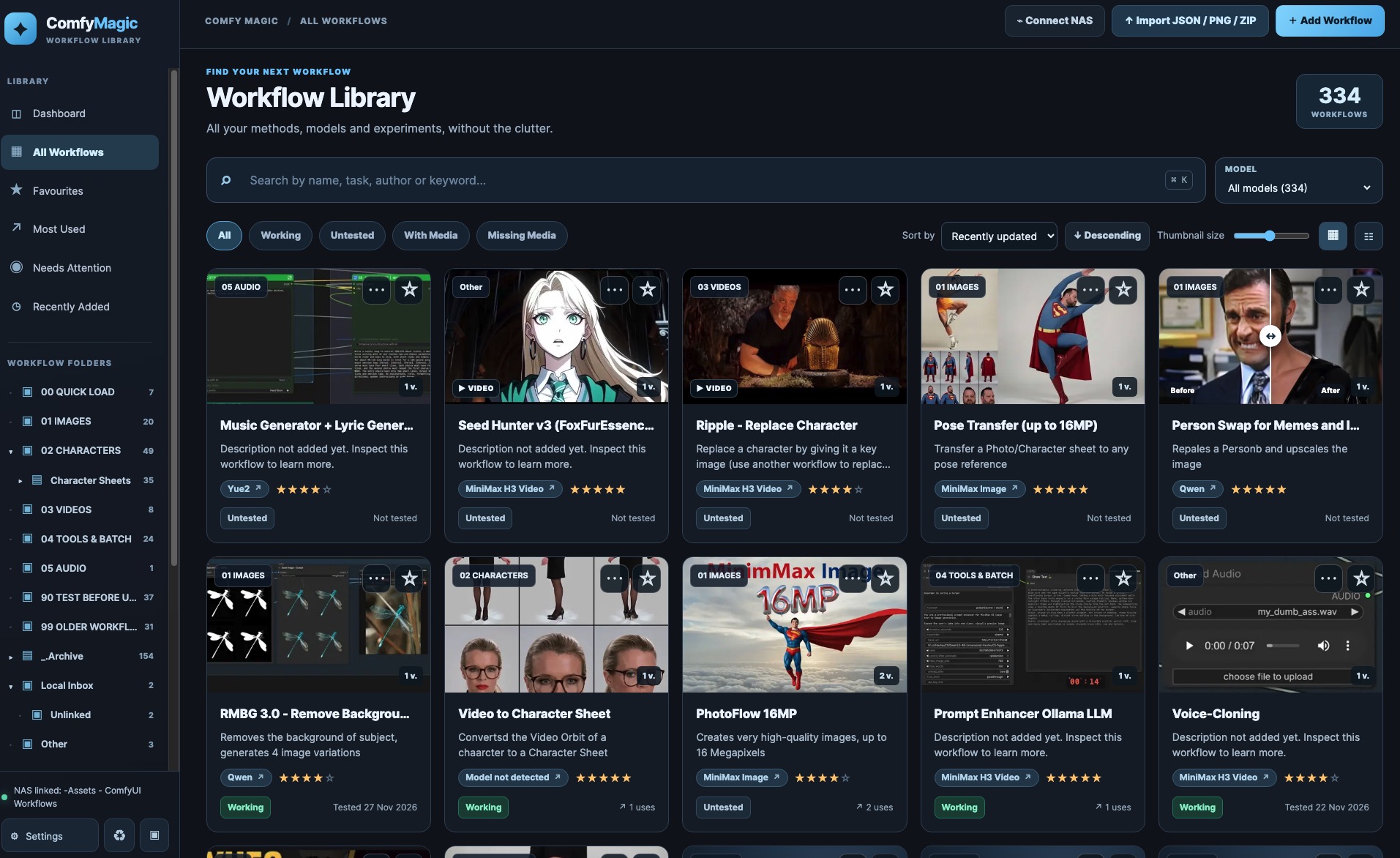
Screenshot
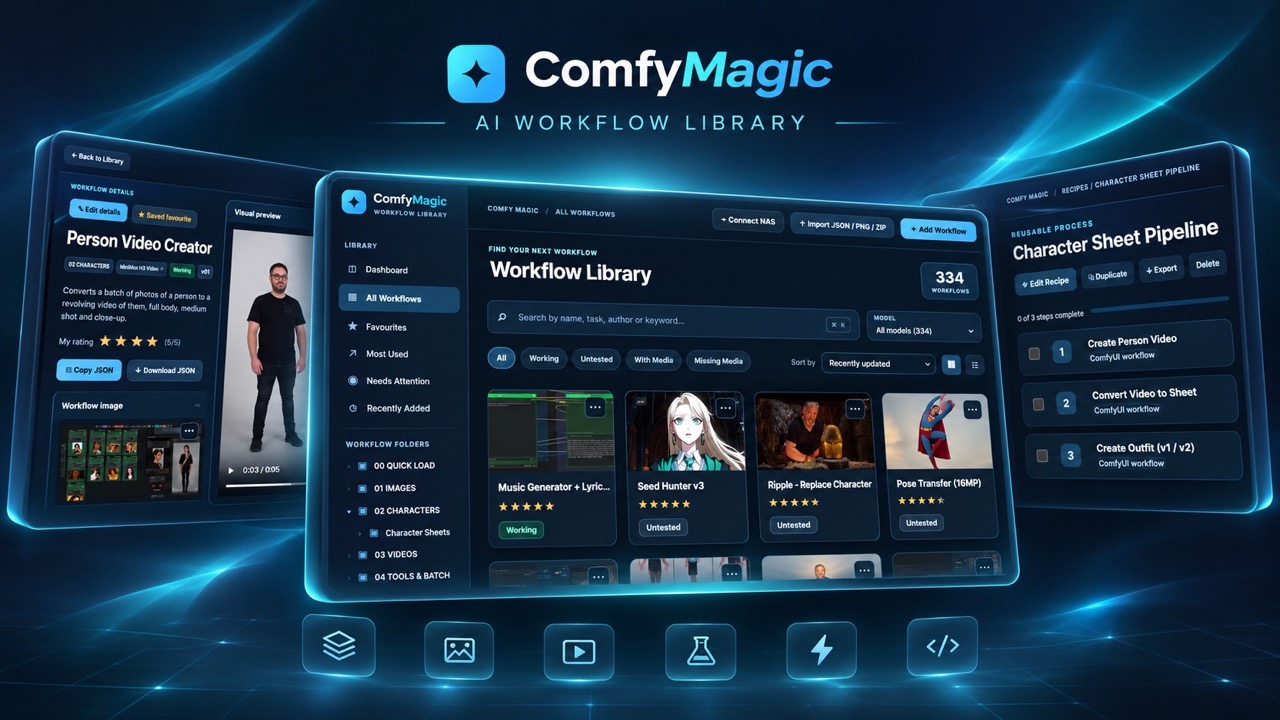
My custom-built workflow library, currently housing over 330 AI workflows.
ComfyMagic is an application I built to organise, manage and quickly access my ComfyUI workflows. I can categorise them, add tags, filter by AI model, rate their performance, save visual examples and keep track of different versions.
When I need to accomplish something, I simply search for the right workflow, copy it into ComfyUI and get to work.
These workflows cover a surprisingly wide range of tasks, including:
- Creating professional product images.
- Generating website design concepts.
- Editing and manipulating photographs.
- Automatically naming website images.
- Creating consistent characters and illustrations.
- Removing and replacing backgrounds.
- Generating and editing videos.
- Creating extremely high-resolution images of up to 16 megapixels, something I’ll be writing about in a future post.
Some are relatively simple, while others are the result of days or even weeks of experimentation.
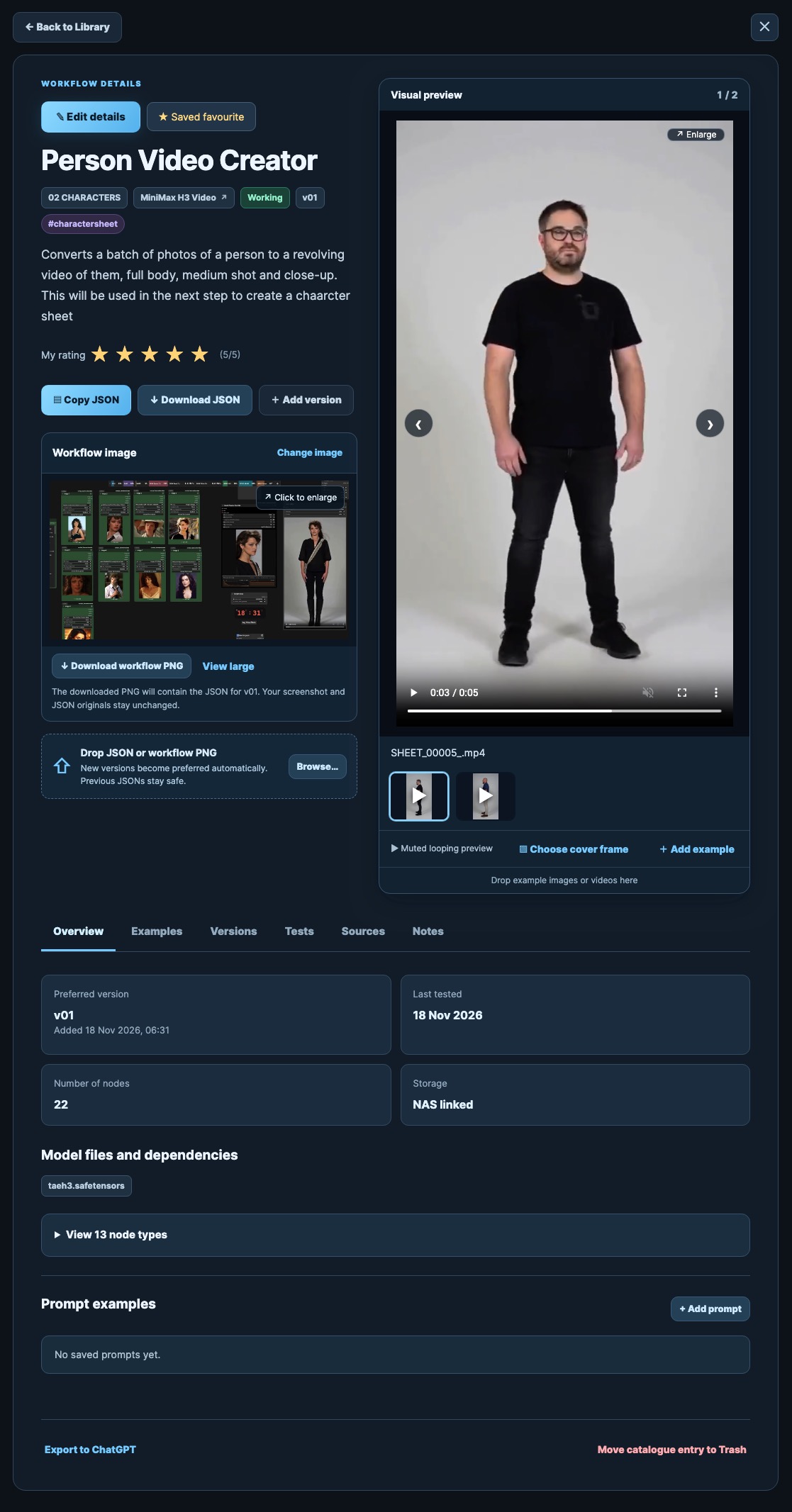
Screenshot
Each workflow has its own description, visual examples, version history, technical information and performance rating.
Why I Prefer Running AI Locally
I’m not particularly fond of subscription-based AI platforms. They certainly have their place, but I prefer having control over the tools I use.
Many online AI platforms use a credit-based system, where each image, video or modification consumes a portion of your monthly allowance. What makes this frustrating as a designer is that getting close to the desired result is often only half the battle. It’s the experimentation, adjustments and attention to finer details that turn a good result into a great one.
Those credits can disappear surprisingly quickly.
Instead, I primarily use ComfyUI, an open-source application that allows me to run AI models directly on my own computer. It allows me to connect different tools and models together to build custom processes for very specific tasks.
There are still hardware and electricity costs involved. My graphics card certainly doesn’t run on positive thinking. But I can queue hundreds of generations, test different approaches and experiment without worrying about a credit counter ticking away in the background.
That freedom makes an enormous difference to the creative process.
Building Better Processes
Screenshot
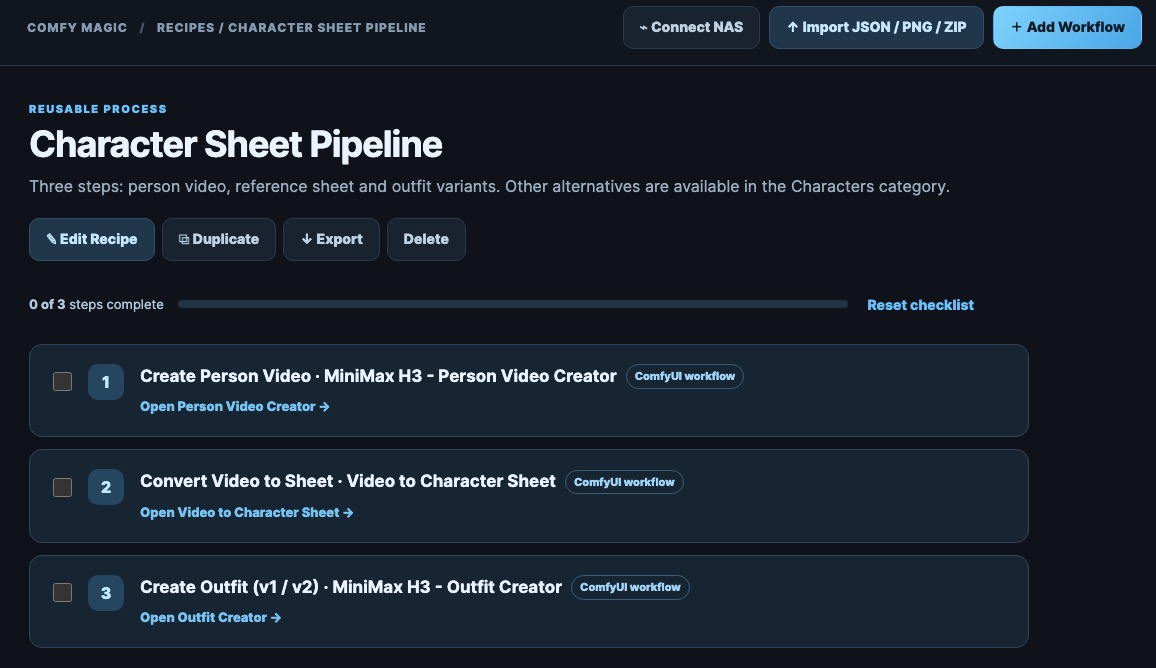
Multiple individual workflows can be combined into a repeatable process for more complex creative tasks.
ComfyMagic also allows me to create what I call recipes. These are combinations of workflows that take me through a particular creative process, step by step.
For example, I can take a collection of photographs of a person, generate a video showing them from different angles, convert that video into a detailed character reference sheet and then create different outfits while maintaining their appearance.
Instead of having to figure everything out from scratch each time, I have a tested process ready to use.
I’ll Spend a Week Saving an Hour
I’ve always believed that if something is worth doing repeatedly, it’s worth finding a better way to do it.
I’m quite happy to spend a week developing a workflow that saves me an hour every day. That investment continues to pay off long after the initial work is done.
It’s also one of the reasons I prefer pricing creative projects according to the work and value involved rather than simply the number of hours I spend in front of a computer. Working efficiently shouldn’t come at the expense of the value of experience, knowledge or the tools I’ve spent years developing.
Ultimately, the purpose of ComfyMagic isn’t just to make my work faster. It’s to give me more time to experiment, explore creative ideas and focus on the details that actually matter to my clients.
Technology should never replace good design. But in the hands of someone who cares about design, it can make an incredible difference to what’s possible.
 About the Author